Community Colleges Know How to Break Generational Poverty: Now We Need to Scale It
What if the solution to generational poverty has been hiding in plain sight? Forsyth Technical Community College has built replicable models that work: 100% high school completion in College Lift, eradicated achievement gaps, and comprehensive wraparound support for thousands. The question is not whether we know how to break the cycle. It’s whether we have investments and trust-based partnerships to scale what already works.
Janet N. Spriggs, Ed.D.
1/5/20266 min read
The beginning of a new year is traditionally a time for creating resolutions focused on our individual ambitions. I, too, spent time thinking about my personal goals for 2026 and developing my personal #oneword for the year: #Momentum. As I reflected on my own purpose and aspirations, I realized that personal growth is only part of the story. The resolutions that matter most in 2026 are not the ones we make for ourselves, but rather the commitments we make together to transform our communities.
For those who know me, you will not be surprised to hear that I believe education, and particularly the work of community colleges, is the key to advancing economic mobility and interrupting the cycle of generational poverty. At Forsyth Technical Community College (Forsyth Tech), we witness firsthand how access to high-quality credentials, wraparound support, and tuition-free pathways transform a student’s life trajectory. We also know that we cannot scale these efforts alone.
At Forsyth Tech, we’ve chosen our own #oneword as an institution: Future-Ready. Being Future-Ready means we’re leading ourselves and our communities beyond "what we have always done” and asking a better question: "What do our students, our communities, and our business partners need right now to be ready for what’s next?" We are building a Forsyth Tech that ensures everyone in Forsyth and Stokes counties, as well as the greater Piedmont Triad region, can rise, thrive, and lead, regardless of their starting point; this is our operational model for the future, not just aspirational words. We are not just talking about innovation; we are building and testing replicable systems. We are tackling poverty, one student, one family, one partnership at a time, but the scale of the challenge demands that we do even more and that we do it together.
Poverty and Prosperity
Prosperity and poverty sit side by side in the Piedmont Triad, and in most communities across our state and nation. When I was named president at Forsyth Tech in 2019, our community was still reeling from Dr. Raj Chetty’s research, which indicated that Forsyth County is one of the most challenging places in America to escape poverty. According to 2025 estimates from the U.S. Census Bureau, compiled by World Population Review, Forsyth County has a median household income of $65,541 and an average income of $44,991; yet, nearly 14.7% of residents live below the poverty line. Stokes County’s median household income is $60,039, and the average income is $42,765, with 11.97% of residents living in poverty.
Both of these percentages are significantly higher than the United States' average of 10.6%, and Forsyth County’s poverty rate exceeds the state’s average of 12.5% by more than two percentage points. In fact, the 2024 American Community Survey (ACS) estimated that 1.35 million North Carolinians had incomes below the poverty threshold, and more than one in eight residents in our state struggle to meet their basic needs. These numbers are not just statistics; they represent neighbors who must choose between rent and groceries or delay workforce education or college because the total cost of attending is out of their reach. Tuition and books do not represent the full cost of attending workforce training programs. When asked to choose between paying for gas to get to class and buying food for your family, the choice is simple, yet it also creates a perpetual cycle of poverty. How do you move up economically, investing in the education you need to secure a family-sustaining wage job, when you cannot afford to invest in the educational program that prepares you for the job?
Moving Families From Poverty to Opportunity
Community colleges offer the most affordable pathway for workforce education in the United States. Whether through a short-term workforce program, an associate in applied science workforce degree, or a transfer associate degree, community colleges prepare students with the knowledge and competencies they need for today’s and tomorrow’s jobs and careers. At Forsyth Tech, we recognize that breaking the cycle of poverty requires more than just classroom instruction. Three initiatives in particular demonstrate our commitment to academic excellence and comprehensive support, both of which are essential to advancing economic mobility.
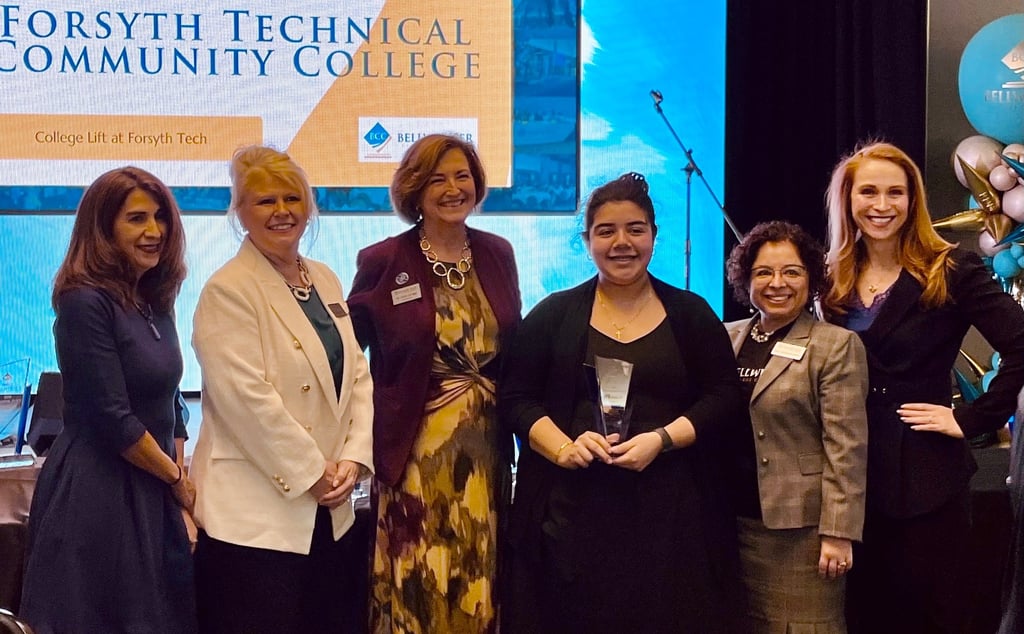
College Lift won the 2025 Bellwether Award and is a seven-year commitment that begins with sixth-graders in Title I schools. Students and families commit to Saturday academies, tutoring, and counseling through high school; in return, graduates receive tuition-free admission to Forsyth Technical Community College or one of our partner colleges. All students in the first and second graduating cohorts, the Classes of 2024 and 2025, have graduated, resulting in a 100% high school completion rate among the College Lift scholars. Notably, all these graduates have either enrolled in college or joined the military. College Lift demonstrates that when we engage with students early and involve their families, we can significantly impact the trajectories of both students and their families.
Forsyth Tech Cares addresses non‑academic barriers that are generally not covered with public funding. Financial aid typically does not cover the obstacles that low-income students face. Forsyth Tech Cares exists thanks to private donations and partnerships. Through emergency “last-dollar” funding and a network of community-based partnerships, our holistic wraparound services help students facing unexpected “life happens” crises like illness, family job loss, delays in financial aid, housing and food insecurity, childcare issues, and transportation challenges, meet basic needs. Forsyth Tech Cares helps students stay enrolled so they can attain the credentials needed to secure high-quality jobs in in-demand fields and break the cycle of poverty.
The Future‑Ready Workforce Alliance brings together education, business, and community partners to tackle the region’s skills shortage. We officially launched this vital work with our founding partner, Reynolds American, in October 2025, and our first Future-Ready apprentice was hired on January 1, 2026! We are eager to expand our network of business partners in 2026. Students, job seekers, and incumbent workers follow flexible pathways that blend classroom learning with on‑the‑job experience. Employers benefit by developing and retaining a highly skilled, future-ready workforce.
These successes demonstrate what’s possible when education, business, government, and philanthropy collaborate. But scaling them requires more than state budgets or tuition revenue. We have done so much, yet the poverty rate in the communities we serve is above the state and national average and more than half of our students do not graduate within three years. If we genuinely want Forsyth and Stokes counties, the Piedmont Triad region, and our great state to move from double‑digit poverty rates to economic and workforce opportunities, we need business partners, public funders, and visionary donors to join us.
The story of Forsyth Tech and our partners shows that generational change is possible: College Lift’s first two cohorts achieved a 100 % high‑school completion and college‑enrollment rate which is much higher than peer students not part of College Lift; Forsyth Tech Cares has helped more than 4,500 students overcome food insecurity, housing crises and child‑care challenges that might otherwise derail their education and our graduation rate more than doubled; The Future‑Ready Workforce Alliance is creating a model for employers to gain and retain a pipeline of skilled workers while learners earn and learn simultaneously. These initiatives have a substantial impact on students and families through collaboration among education, business, government, and philanthropy.
Yet we are serving only a fraction of those who need us. More than 1.35 million North Carolinians live below the poverty threshold, and many more are one emergency away from falling behind. Scaling our programs to meet this need will require investments beyond tuition revenue and state appropriations. We need flexible dollars to expand Saturday academies, fund wraparound support, build data infrastructure, and seed innovation that keeps pace with industry.
A Call to Action to Start a New Year
As we begin a new year, filled with a renewed sense of what could be possible, I am issuing a direct invitation for three critical partners to join us in trust-based partnerships:
Business Leaders: Join the Future-Ready Workforce Alliance and help us build the talent pipeline your industry needs while creating family-sustaining careers.
Elected Officials and Community Members: Advocate for flexible funding that allows community colleges to innovate at the speed of industry, innovation, and student need.
Private Donors and Philanthropists: Invest in proven models that are ready to scale. High-performing community colleges have the necessary data, infrastructure, and track record. Forsyth Tech’s programs are innovative and highly effective, and we are proactively and intentionally engaged in the war on poverty. What we need is catalytic capital to expand and scale game-changing programs like College Lift, strengthen wraparound support, build data systems that demonstrate ROI, and seed the next generation of innovations.
If you believe, as I do, that education is the most powerful lever for economic mobility, I invite you to join us in a conversation about impact. Together, we can ensure that being born into poverty is not a life sentence while we work to build a talented, future-ready workforce.
Let’s make 2026 the year we collectively choose to put poverty behind us, for good.